
Durgashtra logoDurgashtraSelection and assessment guide
Prepare with confidence

Tests, interviews and fitness—clearly explained.

Understand why each stage is used, who may conduct it, what is assessed and how to prepare. The exact process depends on the active vacancy and is confirmed by authorised HR.

Open assessment details
Candidates completing written, interview, group, first-aid and fitness assessments
Detailed assessment stages

Click any stage to see the complete brief.

Not every vacancy uses every stage. Testing must be job-relevant, proportionate, confidential and applied consistently.

01 — Application Q&A and screening
Conducted byAuthorised HR or trained recruiter
Typical formatApplication review and 10–20 minute call
FocusEligibility, availability, communication and role fit

Typical questions

  • Which role and location are you applying for?
  • Can you work the vacancy’s stated roster or shifts?
  • What relevant training, licence or experience do you have?
  • Describe a responsibility you handled reliably.
02 — Written knowledge test
Conducted byHR with operations or subject assessor
Typical format30–60 minutes; MCQ, short answer and scenarios
FocusObservation, reporting, reasoning, safety and communication

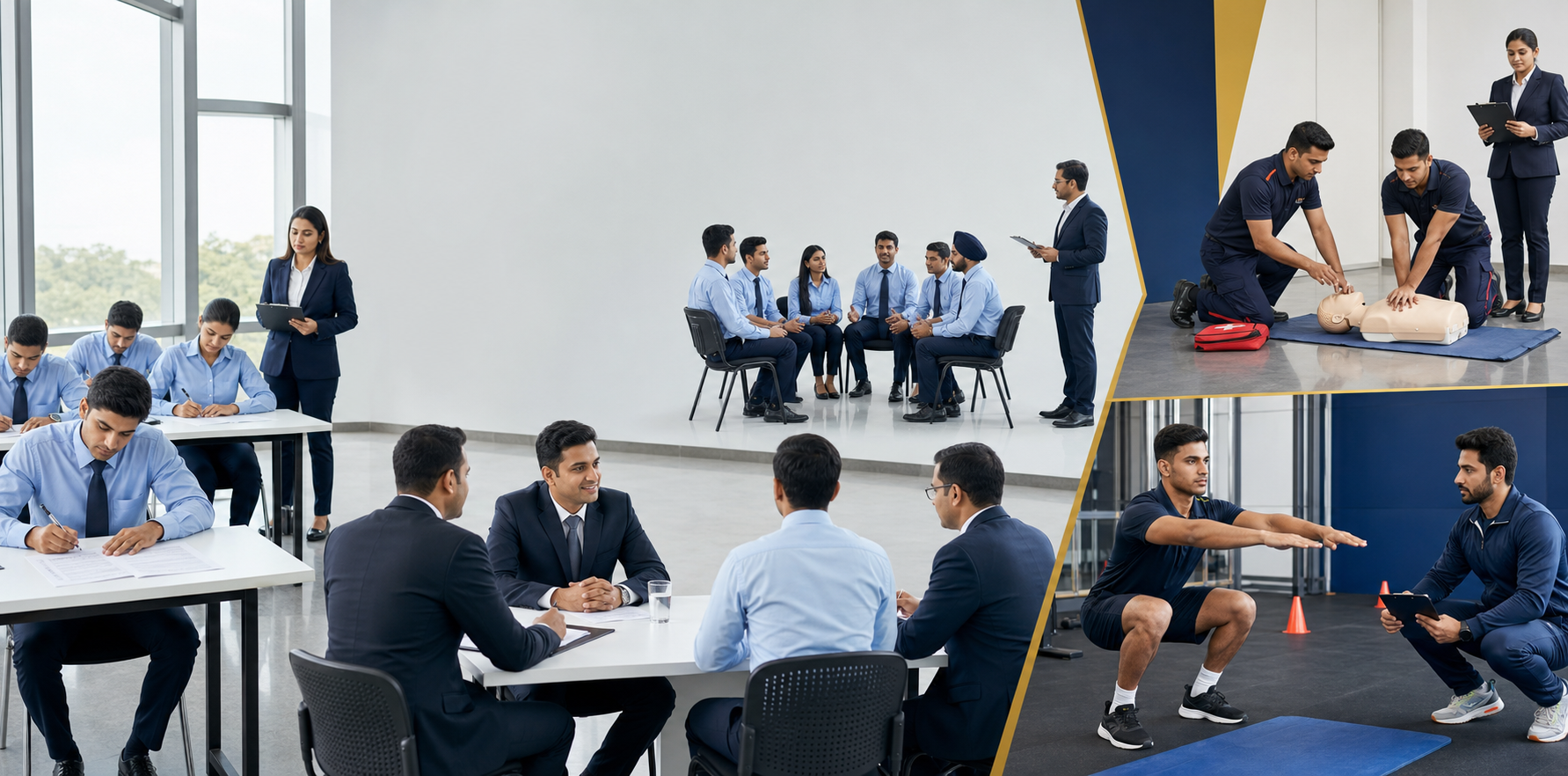
The paper should match the advertised role and language level. It may test incident sequencing, register entries, basic arithmetic, directions, safe escalation and clear written reporting.

See model written paper
03 — Psychological / occupational aptitude assessment
Conducted byTrained assessor; validated instruments by a qualified professional where required
Typical format20–60 minutes; scenarios, attention, reasoning and work-style items
FocusJudgement, integrity, attention, teamwork and response consistency

Possible assessment types

  • Situational judgement: choose the safest response to a workplace scenario.
  • Attention and observation: identify changes, mismatches or missing information.
  • Basic reasoning: sequences, rules, directions and simple problem solving.
  • Work-style inventory: consistent statements about reliability, teamwork and procedure.
  • Integrity scenarios: responses to lost property, access rules, gifts or record accuracy.
Not a diagnosis: this must not be presented as a mental-health diagnosis, lie detector or clinical test. Protected characteristics, disability and medical history must not be used unlawfully. Reasonable accommodation should be available.
See model aptitude items
04 — Safety and first-aid test
Conducted byQualified trainer, first-aid instructor or safety assessor
Typical formatKnowledge questions plus supervised demonstration
FocusScene safety, emergency call, CPR/AED awareness and escalation

Possible practical stations

  • Check scene safety and call the appropriate emergency number.
  • Demonstrate recovery-position awareness on a training mannequin.
  • Explain how to respond to bleeding without exposing yourself to bodily fluids.
  • Identify fire exits, alarm procedure and safe assembly behaviour.
  • Explain what must not be done without training or authorisation.

Practical first-aid or CPR certification is required only if the vacancy states it. Training mannequins—not people—should be used for CPR assessment.

05 — Group discussion / group task
Conducted byTwo trained observers where practical
Typical format5–8 candidates; 15–30 minutes
FocusListening, teamwork, planning, respect and calm problem solving

Model topics and tasks

  • How can a busy hospital improve visitor safety without delaying care?
  • Plan safe crowd entry for a public event with limited gates.
  • Prioritise ten actions after a CCTV and power failure.
  • Design a safe shift handover checklist.
  • Discuss how technology and guards should work together.

Candidates should not be rewarded for dominating. Assessors should score useful contribution, listening, inclusion, evidence, time awareness and respectful disagreement.

06 — Supervision assessment
Conducted byOperations manager and HR
Typical formatCase study, roster exercise and role play
FocusDuty allocation, handover, coaching, incident control and client communication

Model exercise

Two guards are absent, one gate has a queue, a visitor disputes access and the client requests an incident update. Prepare a 20-minute action plan covering immediate safety, team allocation, escalation, documentation and client communication.

Scoring areas

  • Safety and lawful priority
  • Fair, practical allocation of available staff
  • Clear escalation and contemporaneous records
  • Calm communication and follow-up
07 — Structured interview
Conducted byHR and role-relevant panel member
Typical format20–45 minutes using consistent core questions
FocusEvidence, judgement, motivation, responsibility and role readiness

Model interview questions

  1. Why are you interested in this role?
  2. Tell us about a time you followed a difficult procedure correctly.
  3. How would you respond if someone requested unauthorised entry?
  4. Describe a mistake you identified and how you corrected it.
  5. How do you maintain alertness during routine duty?
  6. Give an example of respectful conflict resolution.
  7. What information belongs in an incident report?
  8. How would you protect confidential information?
  9. For supervisors: how do you correct poor performance fairly?
  10. Which location and roster conditions can you genuinely accept?
08 — Medical and physical-fitness assessment
Conducted byQualified medical practitioner; trained fitness assessor for physical tasks
Typical formatConsent-based job-relevant review and safe functional tests
FocusAbility to perform essential duties safely, with reasonable accommodation

Medical areas that may be reviewed

  • Medical history relevant to essential duties, medicines and current limitations.
  • Functional vision and hearing required for the stated role, with permitted correction.
  • Blood pressure, pulse and general clinical review where medically appropriate.
  • Mobility, balance and musculoskeletal function relevant to patrol or standing duties.
  • Any role-specific requirement stated in advance, with confidentiality and informed consent.

Possible safe fitness components

  • Timed walk or role-appropriate endurance check.
  • Sit-to-stand, controlled step or stair activity.
  • Safe lifting/carrying simulation only where an essential duty requires it.
  • Balance, posture and mobility screening.
  • Recovery monitoring and stop rules for pain, dizziness or unsafe signs.
No universal standard: pass criteria must be determined for the specific job through a competent occupational-health and safety process. Tests must not be improvised, punitive or unlawfully discriminatory.
09–10 — Police, education, experience and document verification
Conducted byAuthorised HR and lawful verification provider or authority
Typical formatConsent, document review and source confirmation
FocusIdentity, address, education, experience, licences and certificate authenticity
  • Police/background verification where legally and operationally required.
  • Education confirmation through certificates, institution or authorised verification.
  • Employment confirmation using submitted experience records.
  • Driving, first-aid, technical or instructor credentials where relevant.
  • Discrepancies should be discussed fairly before a decision.

Only the minimum necessary data should be collected. Never request passwords, OTPs or recruitment payment.

11–15 — Offer, appointment, training, field development and confirmation
Conducted byAuthorised HR, operations and training teams
EvidenceWritten offer, appointment, training and review records
FocusClear terms, induction, supervised readiness and fair review
  1. Conditional offer: role, location, pay, benefits, conditions and required checks.
  2. Appointment: accepted written terms and authorised onboarding.
  3. Training: SOP, conduct, reporting, safety and role-specific learning.
  4. Supervised field development: periodic documented reviews; any proposed three-year period must comply with applicable law and signed terms.
  5. Confirmation: written decision based on completed probation, performance, verification, conduct, attendance and a continuing approved role.
Practice material

Model question papers

These examples help candidates understand the style only. They are not the actual examination and do not guarantee selection.

Model Written Test — Security Cadet / Junior Officer

Suggested practice: 30 minutes · 20 marks · no negative marking

  1. A visitor has no appointment but claims urgency. What should you do first?
  2. List four facts required in an incident report.
  3. Gate A recorded 48 visitors and Gate B recorded 37. What is the total?
  4. Arrange correctly: observe, make safe, report, record, follow up.
  5. What is the purpose of shift handover?
  6. Name two examples of confidential information.
  7. A fire alarm sounds. State three safe immediate actions.
  8. What should you do when CCTV time and register time differ?
  9. Write a 40-word report about an unattended bag safely escalated at 10:20.
  10. Why must access rules apply consistently?
Assessment guide: score safe procedure, factual reporting, basic calculation, clarity and escalation. Scenario answers may have more than one acceptable form when the reasoning is safe and lawful.

Model Occupational Aptitude Items

Practice only · not a clinical or diagnostic instrument

  1. You notice a register entry is incomplete. Rank: ignore it; correct it without checking; verify and complete through procedure; blame the prior shift.
  2. A colleague asks you to share a confidential photo. What is the safest response?
  3. Sequence: 2, 4, 8, 16, __.
  4. You receive two conflicting instructions. What steps would you take?
  5. Count the differences between two sample visitor records prepared by the assessor.
  6. Rate honestly: “I check important details before submitting a report.”
  7. Choose the response that best protects safety while remaining respectful.
  8. Explain how you would react after discovering your own reporting error.
Good practice: use validated tools only for their intended purpose. Do not publish a universal “correct personality,” diagnose candidates or coach dishonest responses.

Model Safety and First-Aid Test

Suggested practice: 20 minutes plus supervised demonstration

  1. What must be checked before approaching an injured person?
  2. Who should be contacted and what information should be given?
  3. Why are gloves or barriers important when bleeding is present?
  4. When should an AED be used?
  5. What is the purpose of an assembly point?
  6. Demonstrate emergency-call communication using a role-play.
  7. Identify unsafe actions in a sample fire-exit image.
  8. Explain the limits of your training and when to escalate.

Model Supervisor Assessment

Suggested practice: 40 minutes · written plan and 10-minute briefing

Scenario: A shift starts with two absences, a delivery queue, a malfunctioning access reader and a client visit in 30 minutes.

  1. Set immediate priorities.
  2. Create a temporary duty allocation.
  3. List escalations and records required.
  4. Prepare a two-minute team briefing.
  5. Draft a concise client update.
  6. State the follow-up review you would complete.
Assessment Q&A

Important candidate questions

Will these exact questions appear in the real test?

No. They are examples. The authorised role-specific assessment may differ.

Can I request language or disability accommodation?

Yes. Contact authorised HR before the assessment. Reasonable, lawful accommodation should preserve the essential purpose of the test.

Can one failed component automatically reject me?

The published role criteria should explain any essential pass condition. Decisions should use relevant evidence and a consistent process.

Will my medical or assessment data remain confidential?

It should be collected only when necessary, accessed by authorised personnel and handled according to applicable privacy and employment requirements.